
Here is an automation problem I think we underestimate: you can automate most of a process and still have almost the same problem.
Four steps get faster. Everyone can see it in the demo. Then the request still takes as long as it did before, and nobody is quite sure why.
The answer is usually not in the steps we automated. It is in the one we left alone.
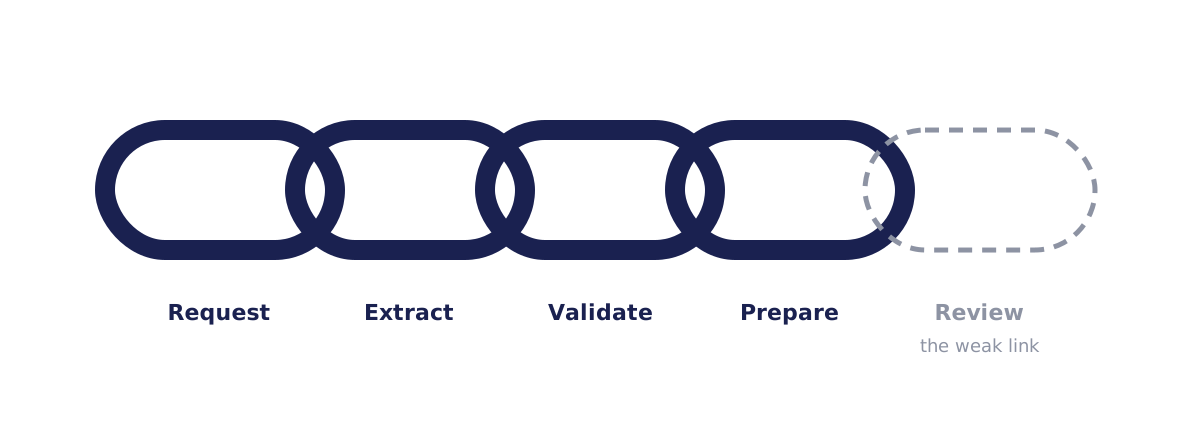
A process is a chain
Charles I. Jones uses the idea of "weak links" in his paper A.I. and Our Economic Future. When a result depends on several essential tasks that complement each other, dramatically improving some of them does not produce the same improvement in the overall result. The tasks that remain become the constraint.
Jones is writing about the economy, not about anyone's accounts payable process. His model is not evidence of what will happen in a particular company. But the shape of the idea is useful for anyone who runs a workflow, and the application below is my interpretation.
Think about a simple request:
- A request comes in.
- The data is extracted automatically.
- The information is validated automatically.
- The transaction is prepared automatically.
- Someone has to review an exception.
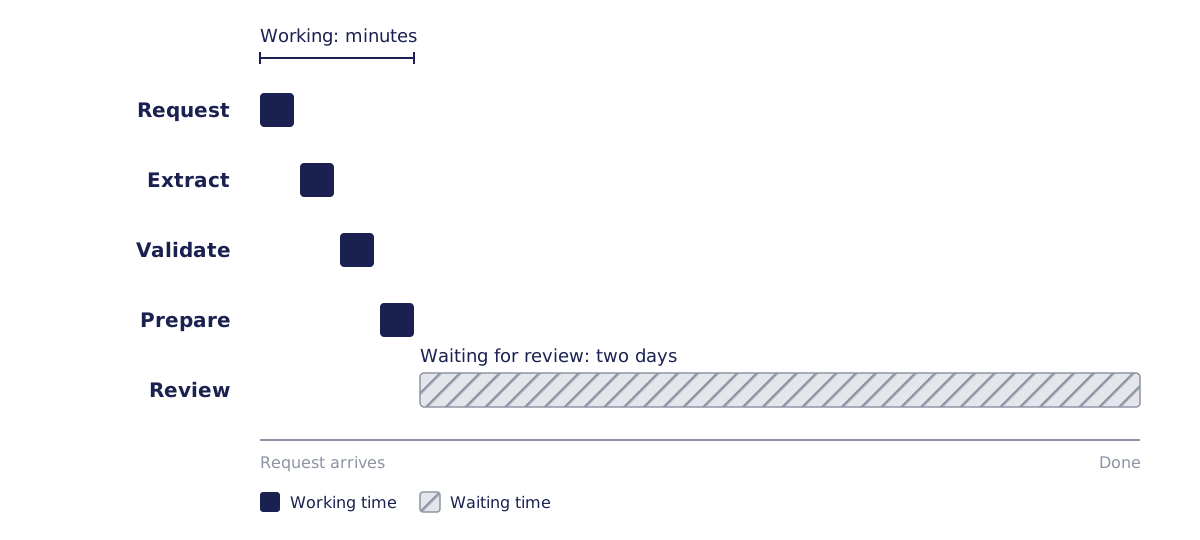
The first four steps may now take minutes. The review sits in an inbox for two days.
The supplier, the employee or the guest waiting on that request still experiences a two-day process. We automated the tasks. We did not necessarily improve the workflow.
This is an illustrative example, not a measured client result.
Working time and waiting time are different clocks
Most automation reporting measures working time: how long a step takes when someone, or something, is actually doing it. That is the clock that improves first, and it is the easiest one to show.
The person on the other end of the process feels a different clock: the total time from the moment the request arrives to the moment it is done. Most of that time is often spent waiting. Waiting for an approver. Waiting for a missing detail. Waiting for someone in another team to pick it up.
"Each step got faster" and "the request got faster" are different claims. Only the second one is what people notice.
Where the work usually waits
In finance and operations, the weak link is rarely a dramatic failure. It is usually ordinary:
- An approval inbox. Nobody owns the deadline, so a two-day wait looks normal.
- An exception queue. Items the rules can't handle collect in one place, often with one person who knows what to do with them.
- Missing information. A request arrives incomplete, goes back to the start, and joins the queue again.
- A hand-off between teams. The request belongs to everyone in theory and to no one while it moves.
- A periodic review. Checks that only happen at month-end turn small issues into a backlog.
None of these is solved by making the automated steps faster. Some are solved by more automation. Many are solved by a clearer rule, a named owner, a target time, or asking for the right detail at the start.
Automation moves the bottleneck
There is another consequence worth expecting.
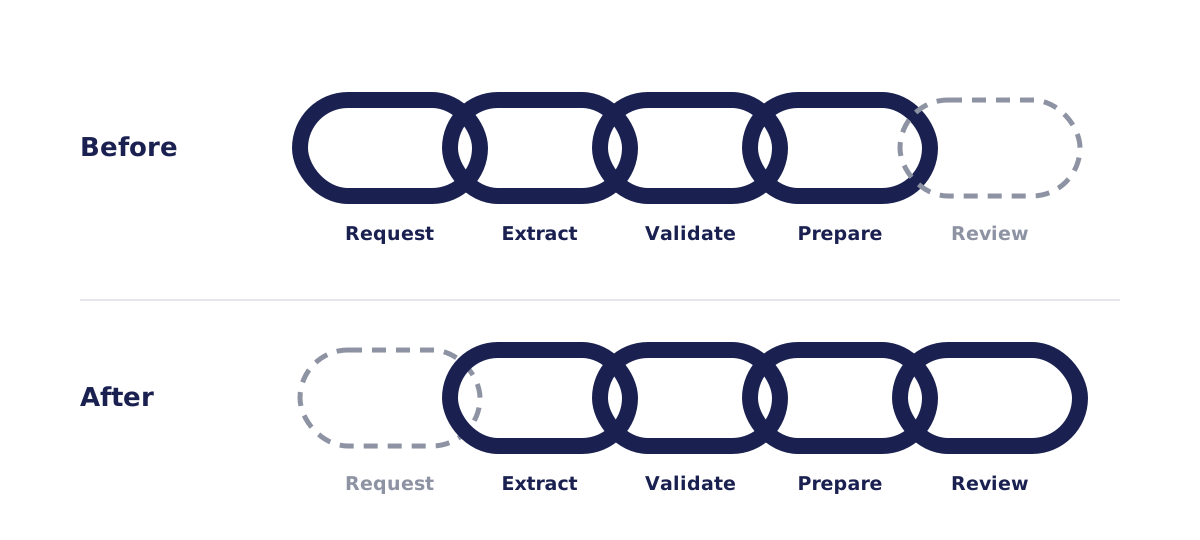
When you fix one weak link, you often expose the next one. The review queue gets an owner and a clock, and suddenly the work waits at the front door instead, because requests arrive missing details.
That is not a failure. It is information. It tells you exactly where to look next.
The goal is not a process with no bottleneck. Every process has a slowest step. The goal is knowing where yours is today, and checking again after every change.
The human step deserves design, not leftovers
Once the system steps are fast, the work usually waits for a person. That is not an argument for removing people from the process. Judgment, accountability and review are often exactly the steps that should stay human.
It is an argument for designing those steps on purpose. A human step that doesn't stall tends to have:
- A clear owner. One name per decision, not a shared inbox.
- A clock. A target time, and a nudge when it slips.
- Everything needed to decide. The context is in front of the reviewer, not three clicks away.
- Only the real exceptions. Routine items are handled before they get there.
One question to ask after every automation
So here is the question I would put ahead of most technology metrics:
Where does the work wait now?
Not "How fast is the bot?" Not "How many transactions did AI process?" Those numbers can be useful, but they describe the tool. Where the work waits describes the process, and it usually tells you more about what to improve next.
A simple way to start: take one real request your team handled last week, follow it from the moment it arrived to the moment it was done, and mark every place it sat still. Circle the longest wait. That is your weak link today. Fix that step, measure the whole request again, and then ask the question again.
Where does the work wait in one of your processes?
Sources and further reading
- Charles I. Jones, "A.I. and Our Economic Future," Stanford GSB and NBER, Stanford GSB Working Paper No. 4305, 15 January 2026. Stanford source record · Author-hosted PDF
The "weak links" idea comes from Jones's discussion of complementary tasks and automation. The workflow examples, the five places work waits and the human-step checklist are Blue Ocean Strategic Partners' application, not claims made in the paper. Timings in this article are illustrative.