
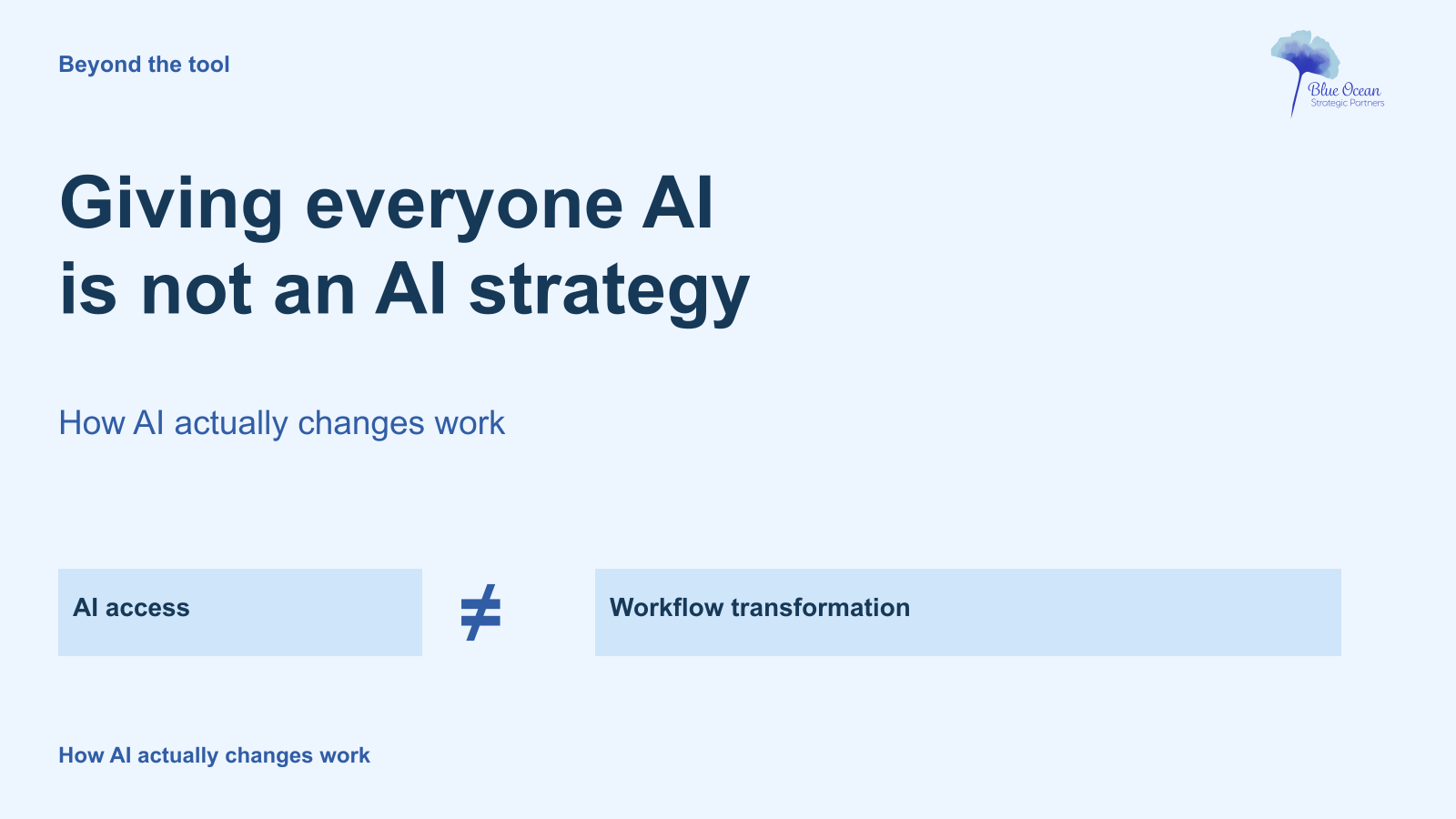
I am increasingly convinced that giving everyone access to AI is not the same thing as having an AI strategy.
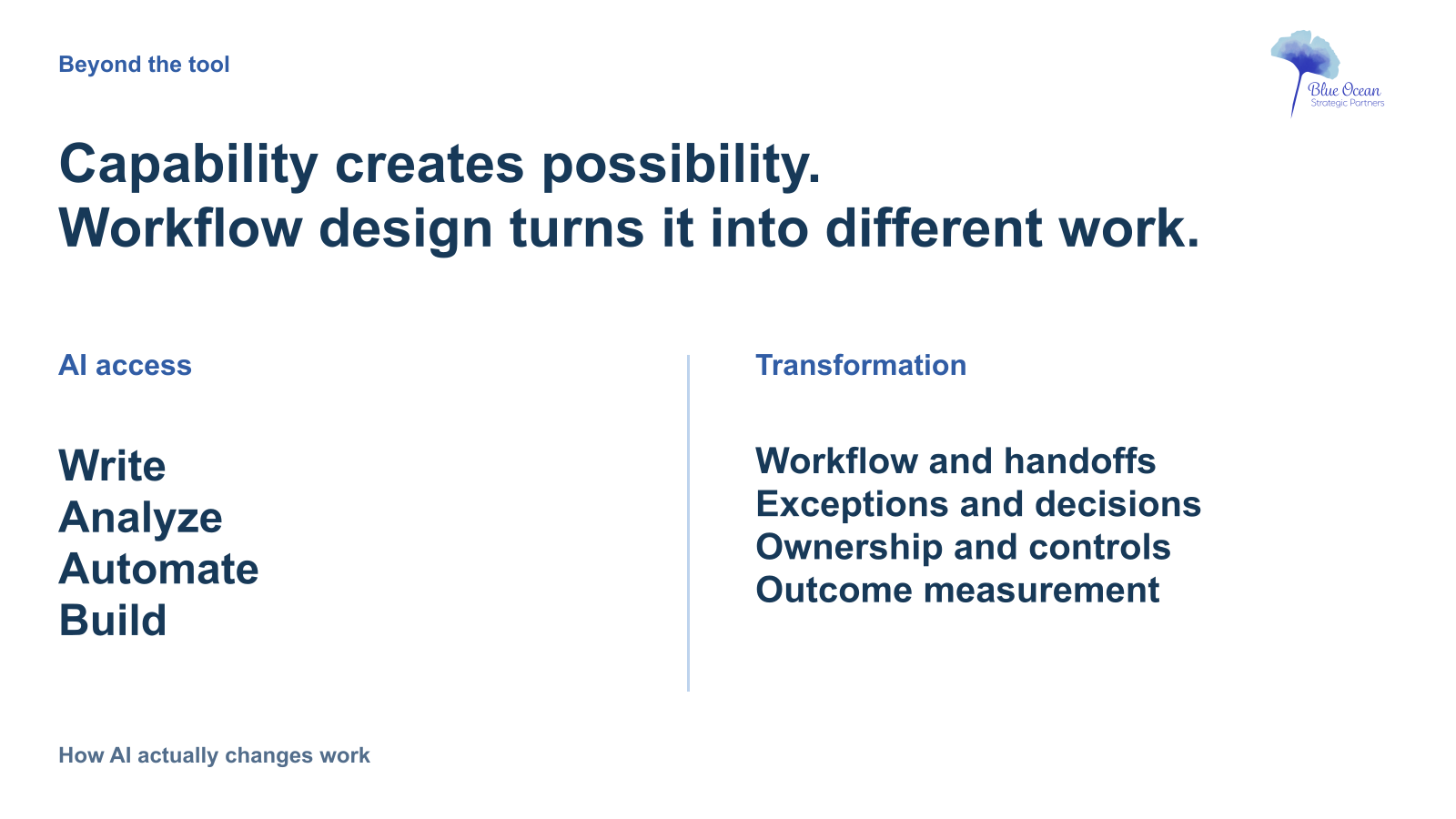
Giving someone a new AI tool gives them a new capability. They may write faster, analyze information differently, build something they could not build before, or eliminate a task they have been doing manually. Those gains matter.
But I think the more useful leadership question comes next: what should work differently now that these capabilities exist?
Capability is the beginning
Benedict Evans makes a useful distinction in his essay AI, tools and transformation: providing technology and changing an organization are different challenges. His comparisons with PCs and web browsers underline the point. Broad access created opportunities, but organizations still had to work out how to change the processes around them.
That is the distinction I want to bring into the conversation about AI at work.
A workflow may cross several people, departments and systems. Each person can become better equipped while the handoffs between them remain exactly as they were. Information can still arrive incomplete. Approvals can still sit in a queue. Exceptions can still land with someone who is unsure who owns the next decision.
The technology changes what is possible. Someone still has to decide how the work should work.
A faster task inside a slow process
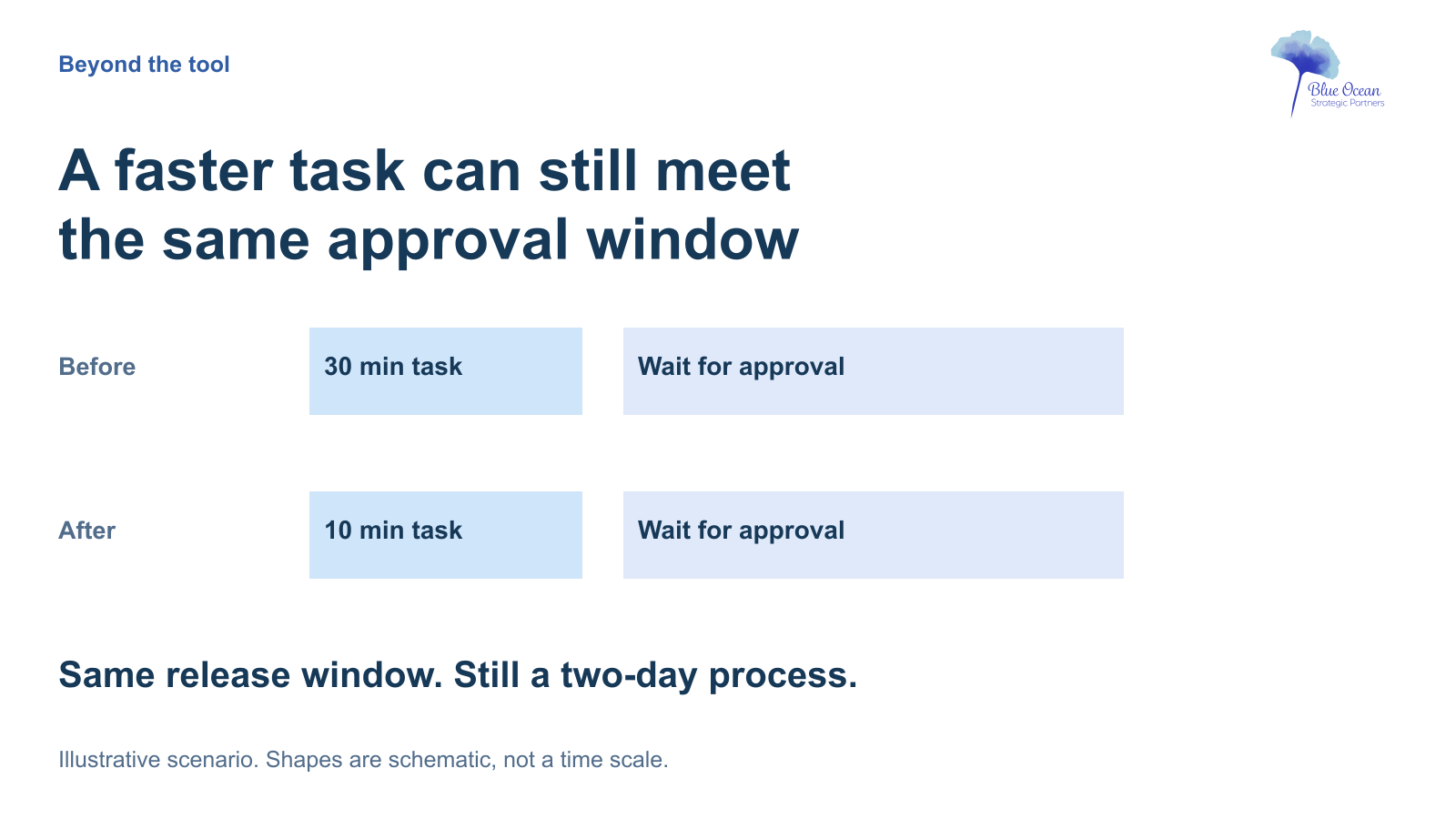
Imagine a task that used to take 30 minutes now takes 10. That is a useful improvement in task time.
Now imagine that the completed work still waits for a fixed approval window two days after the request arrived. If both the old and new versions finish before that same window, the release time may not change at all. The individual has saved 20 minutes. The person waiting for the final outcome still experiences a two-day process.
This is an illustrative scenario, not a measured client result or a forecast. In another workflow, saving those minutes could allow the work to catch an earlier approval window and make a much larger difference. The point is to understand the actual path of the work before claiming an end-to-end gain.
“I finished my part faster” and “the overall work moved faster” are different measurements.
Sometimes improving one step also reveals the next place where work waits. That is useful information. It gives the team a more specific question to investigate: what is holding the work here, and what would have to change for it to move?
Five questions after deployment
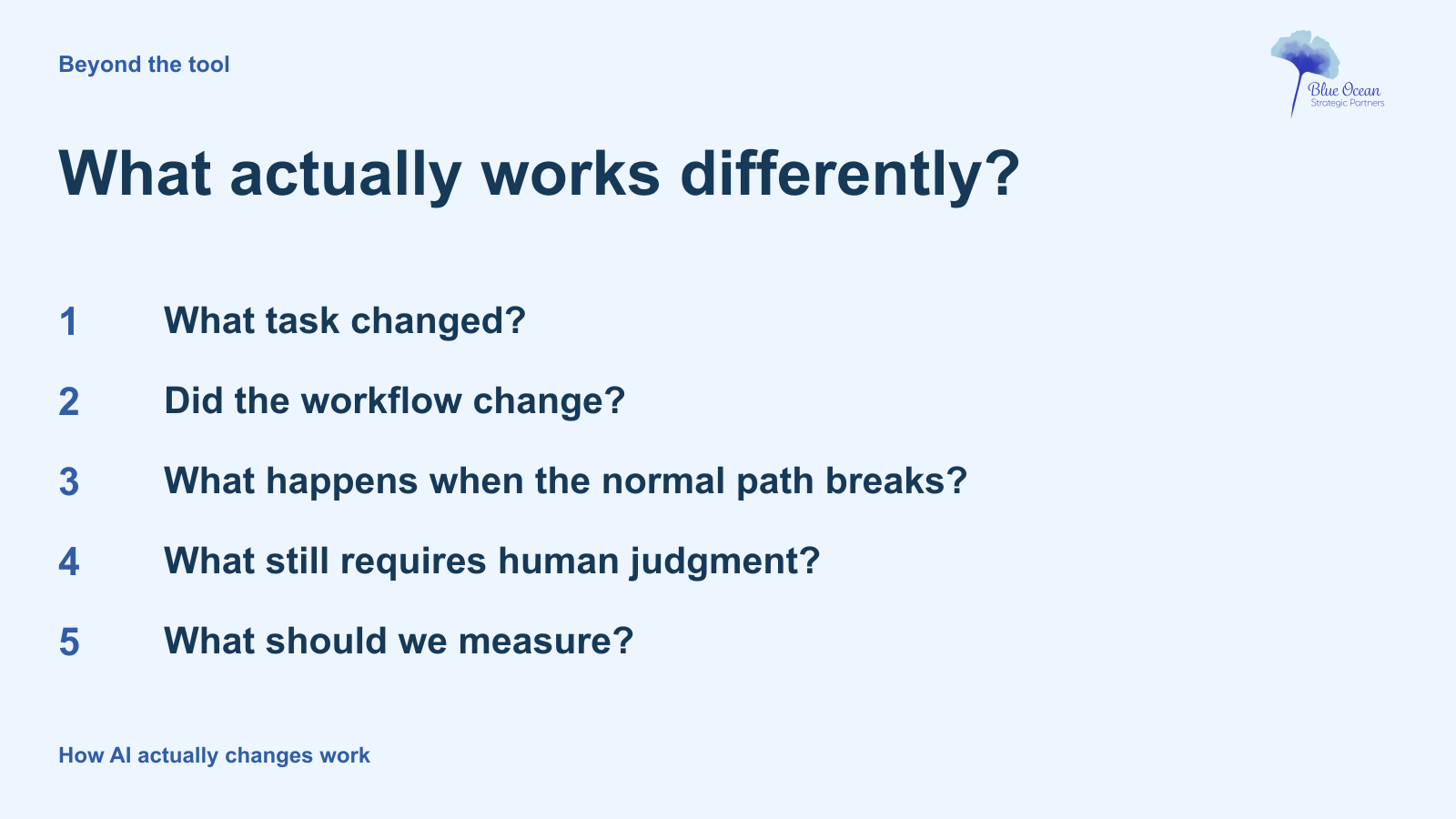
1. What task changed?
“We deployed AI” describes a technology decision. I want to be able to describe the work itself: what someone did before, what happens now, and what is different about the output.
For example, a team might move from manually preparing a first draft to reviewing an AI-assisted draft. That description makes the change concrete. It also makes the remaining review responsibility visible.
2. Did the workflow change?
Look beyond the improved task. Did information move differently? Did a handoff disappear? Did an approval change? Did waiting time decrease, or did it move somewhere else?
A simple before-and-after map can be more useful than a list of tools. Include where the work starts, where it finishes, and who takes responsibility at each handoff.
3. What happens when the normal path breaks?
The standard path is often the easy part. Missing information, unusual requests, overrides and escalations deserve their own design.
Who receives an exception? What information do they need? How does the item return to the normal process? Without those answers, an automated step may simply send unresolved work into a different inbox.
4. What still requires human judgment?
Automation can change where a person's attention is most useful. It does not remove the need to decide who investigates, reviews, authorizes or remains accountable.
I would make that choice explicit. A team should be able to explain which decisions the system can make, which require review, and who owns the outcome when the situation is ambiguous.
5. What should we measure?
Usage tells us whether people are engaging with a tool. To understand the work, we need measures tied to its outcome.
Depending on the workflow, those might include elapsed time, rework, clarity of information, control failures, or the manual effort required as volume grows. Keep the measures small enough that the team can use them, and compare the same start and finish points before and after the change.
The question that should remain
Access to AI can be valuable. Individual experimentation can uncover possibilities that were difficult to see before.
An AI strategy should carry that learning into decisions about the work: which workflow needs to change, who owns that change, and how the organization will know whether it helped.
The question I keep coming back to is simple:
What should actually work differently now that these capabilities exist?
Acknowledgment and further reading
This article is informed in part by Benedict Evans, “AI, tools and transformation”, September 3, 2026. The workflow examples and five-question application are Blue Ocean SP's interpretation. Numerical examples are illustrative.